| You’ve been posting consistently. You’re showing up. You’re doing everything the marketing gurus told you to do. And your inbox is still quiet. Before you spend a single dollar on ads, read this. |
Most business owners believe their lead generation problem is a content problem. So they post more. They try Reels. They go live. They write longer captions. And nothing changes — because the real problem was never the content. It was visibility. And visibility is a fundamentally different thing to fix.
This guide walks you through exactly why your qualified prospects can’t find you, and gives you a step-by-step framework to fix that — without touching your ad budget.
Why Most Business Owners Confuse Lead Generation With Visibility
Lead generation is the process of converting interested people into contacts. Visibility is the process of getting in front of interested people in the first place. If visibility is broken, lead generation never gets a chance to work — no matter how good your funnel, your offer, or your follow-up sequence is.
Here’s how to diagnose which problem you actually have. Open your analytics and look at one number: profile visits or website sessions. If that number is low (under 200 unique visitors per month for a service business at your stage), you have a visibility problem. If that number is healthy but you’re getting no inquiries, you have a lead generation or conversion problem. These require completely different fixes. This guide addresses visibility.
The Three Visibility Blockers (And How to Diagnose Yours)
Blocker 1: Discoverability — The Right People Can’t Find You
Discoverability means showing up when your ideal client is actively searching. On Instagram, that means your display name contains the words they type in search. On LinkedIn, it means your headline contains the keywords attached to their pain point or desired outcome. On Google, it means your website contains the phrases they type at 11pm when they’re finally admitting they need help.
Run this test right now: open Instagram search and type the words your ideal client would type to find someone like you. Not your name. The problem. ‘Funnel help for coaches.’ ‘Business systems consultant.’ ‘Marketing for life coaches.’ Does your profile appear? If not — the algorithm is not showing you to people who are already looking.
| 💡 Quick Fix for DiscoverabilityUpdate your Instagram display name (not your username, the name that appears under your profile photo) and your LinkedIn headline to contain your primary search keyword. This one change costs nothing and begins working within 24–48 hours as the platforms re-index your profile. |
Blocker 2: Clarity — People Find You But Leave in 8 Seconds
Clarity is what happens in the first eight seconds after someone lands on your profile or website. In those eight seconds, your ideal client is asking one question: ‘Is this for me?’ If they can’t answer that question confidently and immediately — they leave.
The most common clarity failure is specificity. ‘I help entrepreneurs grow their business’ is not specific. ‘I help solo consultants build automated lead funnels so they can hit $10K months without working weekends’ is specific. Specific messaging makes the right people feel seen. It may feel like you’re excluding people, but in reality, you’re filtering for quality. The less specific your messaging, the lower your conversion rate — regardless of traffic volume.
| 💡 Quick Fix for ClarityRewrite your bio and website headline using this formula: I help [specific person] do [specific thing] so they can [specific outcome]. Then read it aloud. If it sounds like it could describe three different people, it’s not specific enough yet. |
Blocker 3: Trust — People Understand You But Don’t Reach Out
The third blocker is trust. Someone found you. They understand what you do. But they don’t reach out. Why? Because they don’t have enough evidence that you’ve done this before, that it worked, and that someone like them made the decision and didn’t regret it.
Trust is built through specificity of proof. Not ‘she helped me grow my business’ but ‘$18,000 in program sales in 90 days from a 400-follower account.’ Not ‘great experience working together’ but ’22 hours a week reclaimed and $41K in new contracts by month three.’ The more specific the result, the more believable it is. Vague testimonials create vague trust. Specific results create confident decisions.
The C.O.N.V. Framework: Your Step-by-Step Organic Lead System
Once your three blockers are diagnosed, you need a system to move people from ‘found you’ to ‘ready to pay.’ Here’s the framework used at All Out Virtual across dozens of service business clients.
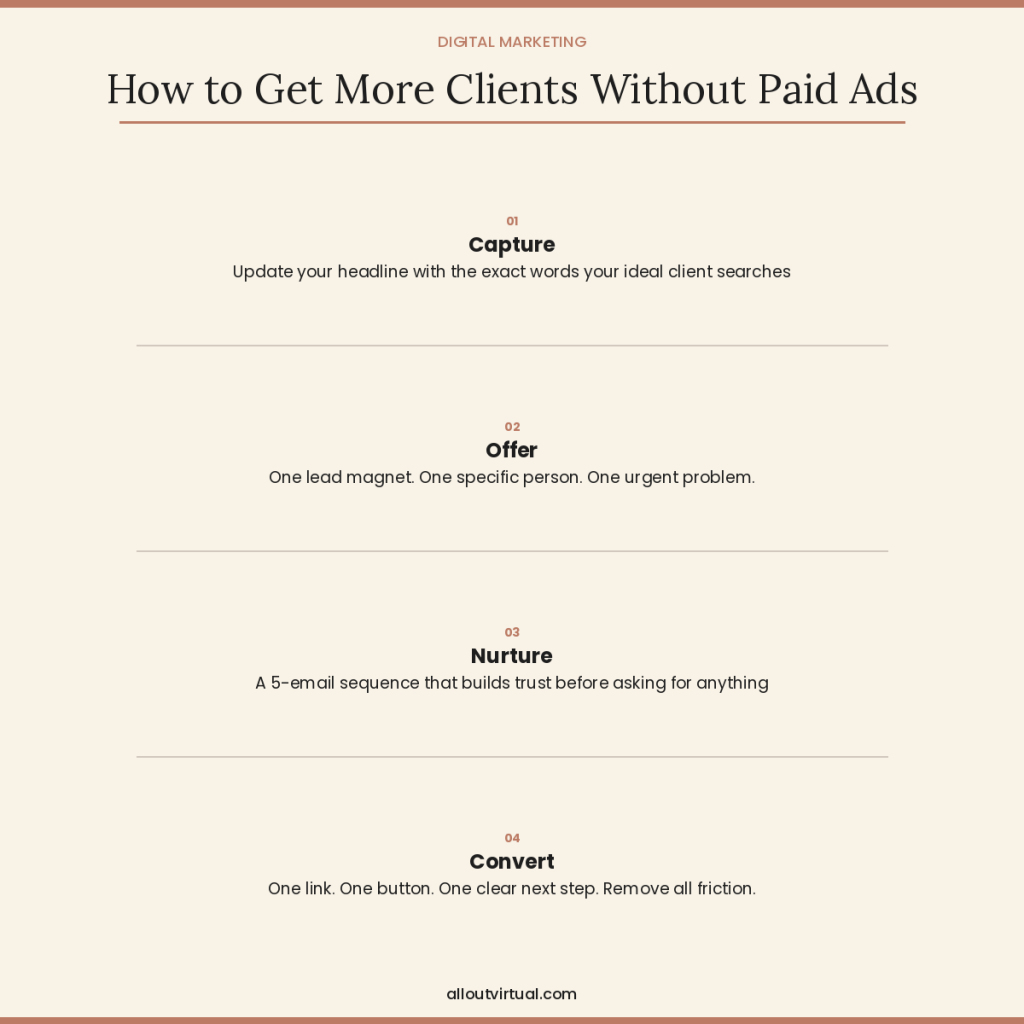
Step 1: Capture — Make Sure You’re Findable
Before anything else, optimize every platform where your ideal client spends time for the keyword they use when they’re looking for help. This means:
1. Instagram display name — Include your primary keyword.
Example: ‘Funnels & Automation for Coaches’ instead of your business name alone.
2. LinkedIn headline — 220 characters max. Include your ICP, your result, and a credibility signal.
Example: ‘Founder @ All Out Virtual | Funnels & Systems for Coaches | Clients avg. $15K–$41K new revenue in 90 days.’
3. Website H1 headline — The very first text a visitor sees on your homepage should answer: who you help and what outcome you create. No creative wordplay. No jargon. Plain language that matches how your client describes their own problem.
4. Google Business or blog SEO — If you publish content, every page title and meta description should include a long-tail keyword phrase your ideal client would type. ‘Business coach’ is too broad. ‘How to get more coaching clients without paid ads’ is exactly right.
Step 2: Offer — Give Them a Reason to Raise Their Hand
Once someone finds you and understands what you do, they need a low-risk way to take the next step before they’re ready to pay. This is your lead magnet. The most effective lead magnets for service businesses are not generic guides — they are hyper-specific resources that solve one urgent, named problem for one specific person.
The best lead magnet titles follow this pattern:
‘The [specific audit/checklist/template] for [specific person] who wants [specific outcome].’ Examples:
• The Website Audit Checklist for Coaches Who Want More Booked Calls
• The 5-Email Nurture Sequence Template for Consultants With No Email List
• The Tech Stack Audit: Which Tools to Keep and Which Ones Are Costing You Time
Format matters less than specificity. A one-page PDF that solves a real, specific problem gets downloaded and acted on. A 40-page guide about everything gets bookmarked and forgotten.
Step 3: Nurture — Build Trust Before You Ask for the Sale
Between ‘downloaded your freebie’ and ‘ready to invest’ is a trust gap. Most service businesses have nothing in that gap except silence. The fix is an automated email nurture sequence — 5 to 7 emails sent over 2 to 3 weeks — that builds the trust required for a confident purchasing decision.
Structure your nurture sequence like this:
1. Email 1 — Empathy — Show that you understand exactly where they are and why it feels hard. Not a sales email. A ‘you’re not alone’ email.
2. Email 2 — Diagnosis — Explain why the problem persists despite their best efforts. Reframe it: it’s not their fault, it’s the approach they’ve been taught.
3. Email 3 — Proof — Share a specific client result with real numbers. One story, told well, with a specific before and after.
4. Email 4 — Method — Explain how your approach is different from what they’ve already tried. Not a features list — a philosophy.
5. Email 5 — Invitation — Offer the next step. Book a call, take an audit, answer a question. One clear action.
Step 4: Convert — Make It Effortless to Say Yes
If you’ve done Capture, Offer, and Nurture well, Convert almost handles itself. The people who reach out at this stage are warm. They’ve consumed your content, read your emails, and already decided they want what you have. Your job now is to make the next step completely frictionless.
One link. One button. One clear ask. Your booking page should have a single action: book a call. No fifteen-field form. No three-step verification. Remove every point of friction between ‘I’m ready’ and ‘call booked.’ Every extra click costs you conversions.
Your 7-Day Implementation Plan
| 1 | Keyword Audit (Day 1)List 10 phrases your ideal client types when they’re looking for help. Pick the 2 most specific and accurate ones. These are your primary keywords. |
| 2 | Platform Optimization (Day 2)Update your Instagram display name, LinkedIn headline, and website H1 using your primary keywords. Don’t overthink the copy — clear and specific beats clever every time. |
| 3 | Lead Magnet Creation (Day 3–4)Write your lead magnet title using the formula above. Create a simple 1–3 page resource that solves the problem the title promises. Use Canva or Google Docs. |
| 4 | Landing Page Build (Day 5)Create a single landing page: headline, 3 benefit bullets, email capture field, one button. Keep the form to first name and email only. |
| 5 | Nurture Sequence (Day 6)Write the first 3 emails in your sequence: empathy, diagnosis, proof. Set them to send automatically after someone downloads your lead magnet. |
| 6 | Bio CTA (Day 7)Add your lead magnet link to every platform bio. Pin your landing page link at the top of your social profiles. Test the entire flow by going through it yourself as a new visitor. |
What to Measure After 30 Days
Once your visibility system is live, track these three numbers weekly:
• Profile visits (Instagram/LinkedIn) — should increase within 2 weeks of keyword optimization
• Lead magnet downloads — your baseline for offer-market fit; aim for a 15–25% landing page conversion rate
• Email open rates on the welcome sequence — healthy open rates are 35–50% for a warm lead magnet audience
These three numbers tell you exactly where the system is working and where to optimize. Low profile visits = still a discoverability problem. High visits but low downloads = clarity or lead magnet relevance issue. High downloads but low replies or bookings = nurture sequence needs strengthening.
| Ready to Fix This in Your Business? All Out Virtual offers a free website and systems audit for service based businesses. We’ll review your current setup, identify your biggest growth blocker, and give you a clear, prioritized action plan — no pitch, no pressure. Book Your Free Audit → alloutvirtual.com/website-audit/ |